
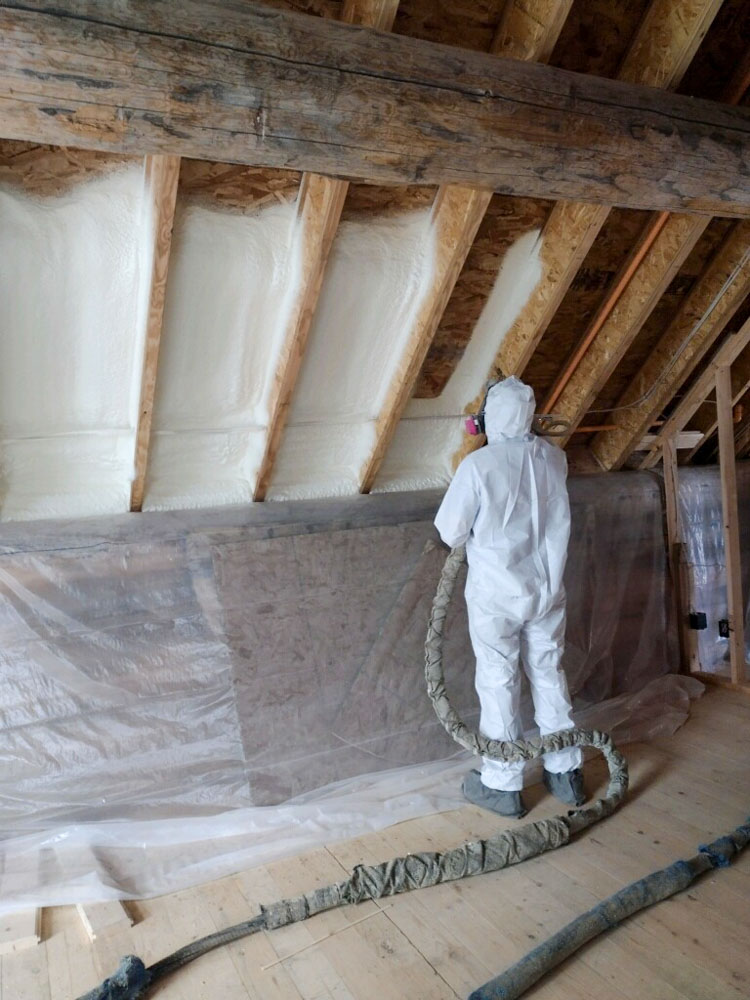
In a climate that spends months below freezing, the choice between closed-cell and open-cell foam is not about which one is “better.” It is about how much R-value you can fit in the cavity you have, and which side of the assembly the moisture is trying to get to.
Here is how the two actually differ, and where each one earns its place in a North Idaho building.
What’s in this guide
The short version
| Open-cell | Closed-cell | |
|---|---|---|
| R-value per inch | About R-3.5 to R-3.8 | About R-6 to R-7 |
| Density | Light, soft, sponge-like | Dense and rigid |
| Air barrier | Yes, at adequate thickness | Yes, at lower thickness |
| Vapor | Vapor-permeable — assemblies can dry through it | Becomes a vapor retarder at roughly 1.5–2" |
| Water | Absorbs and holds water | Rejects bulk water |
| Structure | Adds none | Adds racking strength to the assembly |
| Cost | Lower per square foot | Higher per square foot |
R-value per inch, and why it decides most jobs
Closed-cell delivers roughly twice the R-value per inch. In a cavity with room to spare — a deep vaulted ceiling, a 2x8 rafter bay with no plans for the extra depth — that advantage does not matter much, because you can simply install more open-cell for less money.
It matters enormously when depth is fixed. A 2x6 wall gives you about 5.5 inches. Fill it with open-cell and you land around R-20. Fill it with closed-cell and you are near R-33. When you are trying to hit a wall requirement in climate zone 6 without furring the wall out, that difference is the entire decision.
The same logic applies to a roof deck you cannot make deeper, a rim joist behind a finished basement wall, and any retrofit where the framing is what it is.
Moisture: the part that matters at 10 below
In cold weather, warm indoor air holds moisture and moves toward the cold side of the assembly. If it reaches a surface below the dew point, it condenses. That is how sheathing rots quietly behind an insulated wall.
- Closed-cell at about 1.5 to 2 inches becomes a vapor retarder in its own right. Sprayed directly against the cold surface — a roof deck, a foundation wall, metal panel — it keeps interior moisture from reaching that surface at all. That is why it is the default for crawl spaces, rim joists and metal buildings here.
- Open-cell is vapor-permeable, which is a feature when you want an assembly that can dry inward, and a liability where it lets moisture reach a cold surface. In an unvented roof assembly in a cold climate, open-cell against the deck needs careful design and usually a vapor retarder coating on the interior face.
- Water intrusion behaves differently too. Open-cell absorbs water and holds it; closed-cell sheds it. In a roof assembly, that changes how a future leak shows up — open-cell will show you a stain, closed-cell can hide a leak until it finds another path.
This is the part to get right. Both foams are good products. Most spray foam failures we get called out to look at are not bad foam — they are the wrong foam, at the wrong thickness, on the wrong side of an assembly that had no plan for drying.
Where we use each one
Closed-cell, almost always
- Crawl spaces and foundation walls — ground moisture, cold surfaces, no drying potential downward
- Rim joists — a classic condensation location and a major air leak in most homes
- Unvented roof decks — the cold-climate assembly where vapor control is doing real work
- Metal buildings, shops and pole barns — steel panel is the coldest surface in the building and condensation forms on it readily
- Any place depth is limited — retrofits, 2x4 walls, shallow rafters
Open-cell, where it fits
- Interior walls for sound — it is genuinely good at this and cheaper
- Deep cavities where you can buy depth instead of density
- Assemblies designed to dry inward, detailed by someone who has thought it through
The hybrid nobody talks about
Flash-and-batt — an inch or two of closed-cell against the sheathing, then fiberglass or blown-in filling the rest of the cavity — gets you the air seal and vapor control where it matters, then buys the remaining R-value with the cheaper material. On a lot of North Idaho walls it is the best dollar-for-dollar assembly available, and it is worth asking about before you assume the whole cavity has to be foam.
The detail that makes or breaks it is thickness of the foam layer: too thin and the sheathing still gets cold enough to condense. That is a calculation, not a guess.
Which one does your building need?
The answer depends on the assembly, the cavity depth, what is above and below it, and what the building is used for. We are an owner-operated crew in Hayden and we work on both sides of this every week — new construction, remodels and retrofits, and commercial and metal buildings across Coeur d’Alene, Post Falls, Sandpoint and Harrison.
Tell us what you are building or fixing and we will tell you which foam belongs there and why. Get in touch, or see the work in our gallery.
Frequently asked questions
What is the difference between closed-cell and open-cell spray foam?
Closed-cell foam is dense and rigid, delivers about R-6 to R-7 per inch, becomes a vapor retarder at roughly 1.5 to 2 inches, rejects bulk water and adds strength to the assembly. Open-cell is light and sponge-like, delivers about R-3.5 to R-3.8 per inch, stays vapor-permeable so assemblies can dry through it, absorbs water, and costs less per square foot.
Which spray foam is better for cold climates?
Neither is universally better; it depends on the assembly. Closed-cell is the usual choice in North Idaho for crawl spaces, rim joists, unvented roof decks, metal buildings and anywhere cavity depth is limited, because it controls vapor and gets more R-value into less space. Open-cell fits interior walls for sound, deep cavities where you can add thickness instead of density, and assemblies specifically designed to dry inward.
Can open-cell foam be used on a roof deck in a cold climate?
It can, but it has to be designed carefully. Open-cell is vapor-permeable, so in an unvented roof assembly in a cold climate it typically needs an interior vapor retarder coating to keep indoor moisture from reaching the cold deck. Closed-cell handles that vapor control on its own, which is why it is the more common specification here.
What is flash-and-batt?
A hybrid assembly: an inch or two of closed-cell sprayed against the sheathing for air sealing and vapor control, with fiberglass or blown-in filling the rest of the cavity to reach the required R-value. It is often the best dollar-for-dollar wall assembly, provided the foam layer is thick enough to keep the sheathing above the dew point, which is a calculation rather than a guess.
Need a number for your building?
NW Spray Foam & Insulation is a family-owned, owner-operated crew in Hayden serving Coeur d’Alene, Post Falls, Sandpoint, Harrison and the surrounding North Idaho communities. Tell us what you are building or fixing and we will spec it properly and put it in writing.
Request an estimate Call (208) 818-4170More insulation guides
Cost Guides
How Much Does Spray Foam Insulation Cost in North Idaho?
August 21, 2026 · 8 min read
2026 price ranges for open-cell and closed-cell, what each area of a building typically costs, and how to compare two bids that do not match.
Read the guide →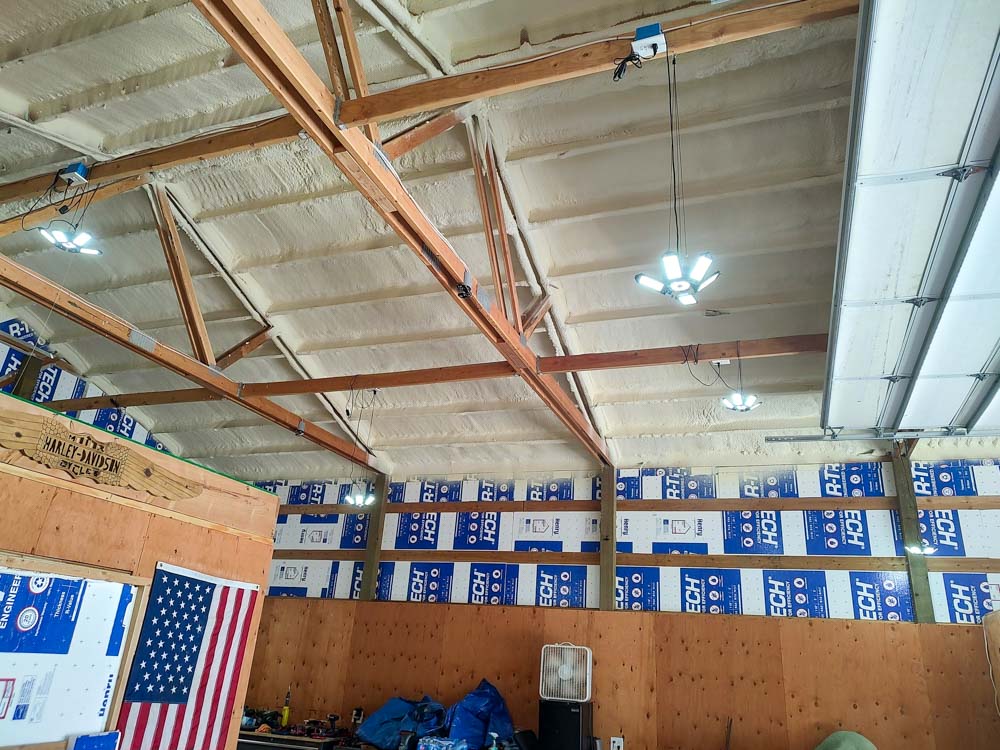
Shops & Metal Buildings
Insulating a Pole Barn or Shop in North Idaho
August 21, 2026 · 8 min read
Why condensation control, not R-value, drives the specification on steel buildings, and what actually works on a heated shop here.
Read the guide →
Permits & Code
What R-Values Does North Idaho Code Require?
August 21, 2026 · 7 min read
Climate zone 6 targets for ceilings, walls, floors and crawl spaces, what the Idaho amendments changed, and the air-sealing requirement people forget.
Read the guide →